
1 min read
Enrollment Is Declining: Why School Operations Matter More
Strong enrollment strategies rely on more than admissions.They depend on operations that can consistently deliver the experience families are...
9 min read
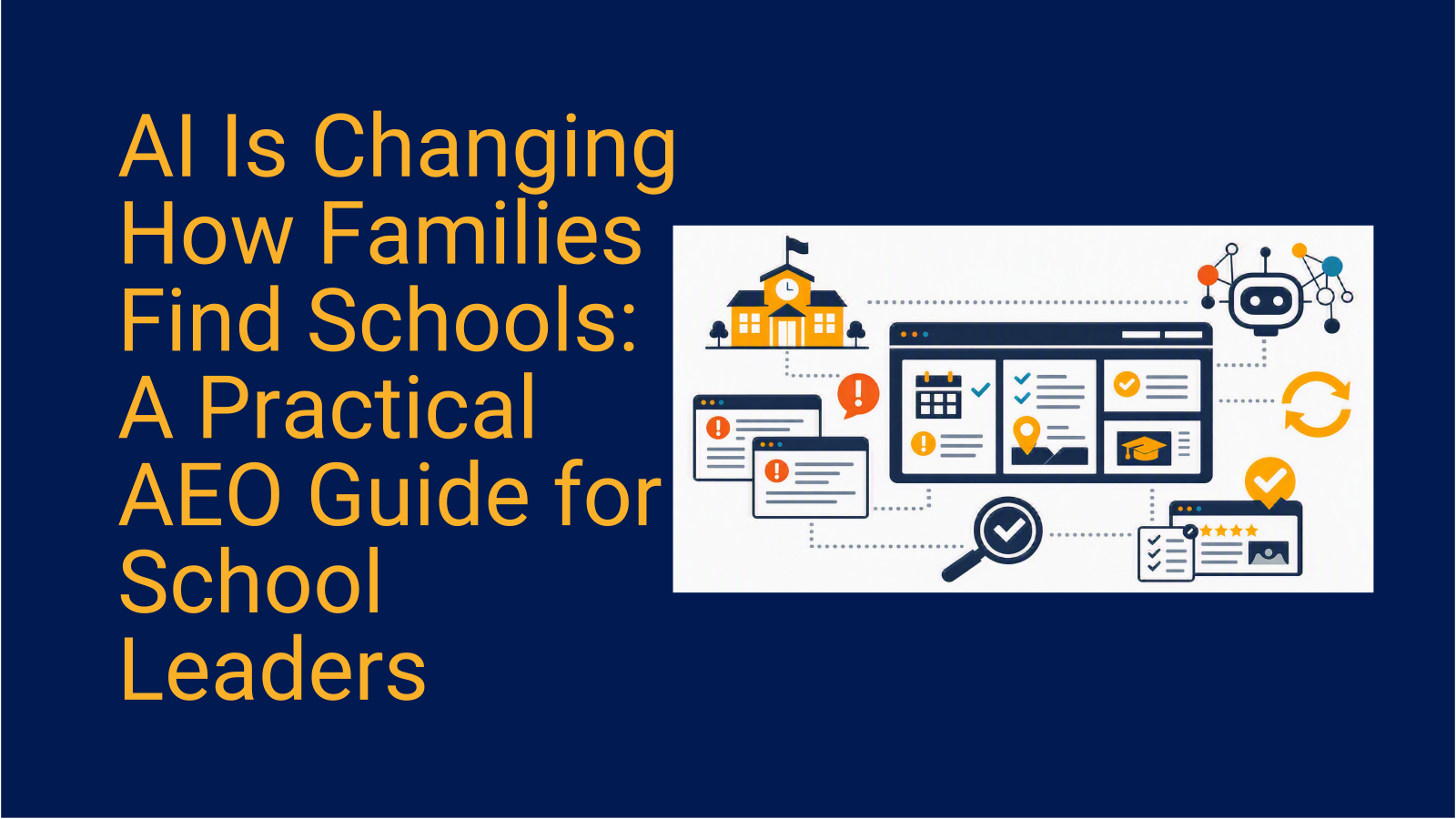
Right now, somewhere in your enrollment zone, a parent is asking an AI assistant about your school.
They are not scrolling through ten blue links. They are asking ChatGPT, Claude, or Gemini a direct question — "What are the best schools near me for a kid who loves science?" — and getting a direct answer.
The question every school leader should be asking is a simple one: what is the AI saying about your school? Because it is answering either way. The only thing you control is whether it answers with current, accurate information from your website — or with whatever fragments it happened to find.
For most organizations, this is a marketing curiosity. For schools — charter, private, or district — it is an operational readiness question, because enrollment is revenue. If an AI assistant cannot find complete, current answers about your school, you may quietly drop out of a family's consideration set before you ever knew they were looking.
This is not a forecast about where family behavior is headed. It has already happened.
According to a 2025 Adobe survey, roughly one in four U.S. ChatGPT users now turns to the tool first, before a traditional search engine. A more recent study reported by Search Engine Land puts the share of consumers starting their searches with AI at 37%. And families who never open a chatbot at all are still seeing AI-generated answers: Pew Research finds six in ten U.S. adults now read the AI summaries that sit at the top of search results — above the links your school has spent years working to earn.
The practical upshot is that a growing share of families are forming a first impression of your school without ever visiting your website. They are getting a summary, generated by a machine, from whatever that machine could find and understand. Your job is no longer only to get families to your site. It is to make sure the answers about your school are correct wherever those answers are being assembled.
For a decade, the enrollment web playbook was search engine optimization. You worked the right keywords into your pages, Google ranked you, and a family clicked through to explore on their own. The website was a destination, and your job was to drive traffic to it.
AI search inverts that. Instead of matching keywords and handing a family a list of links to explore, AI agents crawl websites looking for complete answers they can lift directly into a conversation. The family often never arrives at your site at all — they get the answer, in the AI's own words, and move on. This is the discipline now being called answer engine optimization, or AEO: structuring your content so an AI can find, understand, and accurately repeat what makes your school worth considering.
The difference is easiest to see in an example. Under the old model, a STEM-focused school might have sprinkled "STEM school near me" across its blog and hoped to match a parent's search. Under AEO, the keyword is beside the point. What matters is whether your website actually explains what your STEM program is, how it differs from the school down the road, and what a child's day would look like inside it. The AI is not hunting for a phrase to match. It is hunting for an answer to give. The marketing research is now explicit about this: analyses of AI citation patterns, including the AirOps 2026 State of AI Search Report, find that AI systems favor pages that lead with a clear, direct answer backed by evidence, and that content formatted as genuine question-and-answer is among the most likely to be pulled into an AI response.
Here is the operational risk hiding in that shift: when an AI cannot find a current answer, it does not stay silent — it uses an old one. The most cited cautionary case comes from outside education, but the lesson transfers directly. When a customer relied on an Air Canada support chatbot that gave incorrect information based on outdated policy, a tribunal ruled the airline was liable for what its bot told the customer and ordered it to pay. The mechanism is the same one that will quietly misinform a prospective family: AI tools retrieve the best document they can find and answer from it, with no way of knowing the content is stale. If last year's calendar or an old enrollment deadline is still live on your site, that is the answer a family may receive — delivered with total confidence and no warning label. Every stale page on your website is now a potential wrong answer waiting to be served.
Preparing for AI search does not require a marketing team, a new budget line, or specialized expertise. It requires treating your digital presence the way you already treat any operational system: audit it, fix what is broken, and put it on a maintenance schedule. Here is where to start.
Before you change anything, see what a family sees. The fastest way to do that is to ask an AI assistant to walk through your enrollment experience and tell you where it breaks down. Enrollment strategist Vanessa Barry shared a version of this prompt on Episode #73 of The Charter School Insider Podcast, and it is the simplest place to start:
"Please evaluate the application and enrollment experience for a family who may want to enroll their student at [School Name] ([website URL]). Identify what is working well, where there is friction or confusion, and what specific improvements we should make."
One tip that makes a real difference: be explicit that you mean the family experience. Left vague, the AI may evaluate your staff hiring application instead.
What comes back is often uncomfortable in a useful way. Schools that run this exercise routinely surface problems that accumulated invisibly as they grew — grade ranges that read K–2 on one page and K–3 on another, dead links, forms that error out, and calls to action that push "Enroll Now" at families who are still just exploring. None of these are anyone's fault. They are the ordinary byproduct of a growing organization where content lives in more places than any one person can track. But every one of them is now something an AI might repeat to a prospective family, so every one is worth fixing.
FAQs are the single format AI agents are best at consuming: a clear question, followed by a complete answer. That is exactly the structure these tools are looking for — marketing analysts, including HubSpot, now describe adding a genuine FAQ section as one of the highest-impact things any organization can do to show up in AI answers. If your FAQ has not been touched in years — or if you quietly retired it when the blog fell dormant — rebuilding it may be the highest-leverage hour your team spends this quarter.
Cover the questions families actually ask, not the ones that are convenient to answer: grade levels served, enrollment windows and deadlines, transportation, meals, before- and after-care, tuition or fees where they apply, special education services, and — most importantly — what makes your model genuinely different from the other options a family is weighing. The more completely you answer, the more raw material an AI has to represent you well.
Academic calendars. Enrollment deadlines. Open house and tour dates. Tuition and fee information where it applies. Anything with a date attached is now a liability the moment it goes stale, because AI tools will serve it to families as though it is current. This is not a nice-to-have: analyses of AI search find that freshness is one of the strongest predictors of whether a page gets cited, with pages that are not updated regularly losing AI citations at a markedly higher rate than those that are.
Treat this like any other compliance obligation: assign an owner and a refresh cadence. A dated page nobody owns is a wrong answer nobody is watching.
Most schools set up a bare Google Business Profile years ago — address, phone number — and never returned to it. There is far more room there than most leaders realize: photos, a full description, posts and updates, and a Q&A section. AI tools draw on these off-site listings, not just your website, when a family asks about schools nearby, and keeping them accurate and complete is a recognized AEO fundamental. It costs nothing but attention — and it is worth confirming your name, address, grade levels, and hours are consistent everywhere they appear online, since AI systems also pull from old directory entries that may still list outdated information.
A to-do list tells you what to start. Just as valuable — and rarer in the how-to content flooding this topic — is knowing what not to do, and where to hold steady while everyone around you overcorrects.
Do not let the pendulum swing too far toward AI in what families see. As schools race to adopt AI, it is tempting to lean on it for the parent-facing work too — auto-generated flyers, AI-written social posts, stock-style graphics. Resist that in the materials families actually see. Parents have become remarkably good at spotting AI output: the too-perfect image, the empty background, the generic cadence of machine-written copy. At the exact moment a family is looking for signals that your school is distinct and personal, obviously synthetic content works against you. Use AI for efficiency behind the scenes; keep the front-facing experience unmistakably yours.
Do not abandon SEO — this is a both/and. Most families still search the traditional way, and AI summaries now appear inside those traditional results anyway. This is one of the most common mistakes marketing analysts flag: treating AEO and SEO as an either/or when strong SEO is actually what feeds AI results in the first place. The goal is not to pivot from SEO to AEO; it is to serve both a family typing keywords into Google and an AI assembling an answer. A strong website, an active social presence, and your paid strategies all still matter. AEO is a layer you add, not a replacement for the foundation.
Draw a hard line on student data. As your team brings AI into daily work, one rule needs to be non-negotiable and circulated before someone learns it the hard way: never paste identifiable student information into an AI tool, and be especially careful with free consumer accounts, where you have the least control over how inputs are handled. If you are using AI to analyze enrollment or application data, strip names and use anonymized identifiers only. This is worth a short, explicit staff guideline — the convenience of these tools makes it very easy for a well-meaning staff member to paste in exactly the wrong thing, and student records carry legal protections a marketing team may not have front of mind.
Do not mistake efficiency for the relationship. AI can make your school easier to find and your team faster. What it cannot do is shake a parent's hand on a campus tour. Choosing a school is one of the most personal decisions a family makes — in some cases a thirteen-year commitment made when a child is four or five. The technology is changing how families find schools. It has not changed why they choose them.
Audit what the AI sees → Fix what is stale or missing → Keep it current year-round
The steps build on each other. The audit tells you where you stand. Fixing your FAQ, your dated pages, and your listings closes the gaps an AI is most likely to stumble on. And a maintenance cadence keeps those fixes from quietly decaying back into wrong answers. Each step trades a little effort now for a lot less risk of misinforming a family later.
AEO is the practice of structuring website content so AI tools like ChatGPT, Claude, and Google's AI Overviews can find and accurately repeat complete answers about your organization. For schools, that means thorough FAQs, current calendars and enrollment details, and pages that fully explain programs rather than just repeating keywords.
Yes. Most families still use traditional search, and AI-generated summaries now appear within those results too. Strong SEO also directly feeds AI answers, so the strongest position serves both: keyword relevance for traditional search and complete, current answers for AI tools.
Ask them directly. Prompt an AI assistant to evaluate your school's enrollment experience from a family's perspective, and ask the common questions parents ask — first day of school, grade levels, how to apply. The answers show you exactly what prospective families are seeing, and where your website needs updating.
Update or create an FAQ page and refresh anything with a date on it — calendars, deadlines, event pages. Complete, current answers in question-and-answer format are precisely what AI agents index, and outdated content is what leads them to give families wrong information.
Only with care. Never enter identifiable student information into an AI tool, and be especially cautious with free consumer accounts. If you are analyzing enrollment or application data, remove names and use anonymized identifiers, and set a clear staff guideline so the rule is understood before anyone tests it.
School leaders who treat their website as a brochure they built once are treating one of their most active enrollment tools as set-it-and-forget-it. That worked when families visited the site on their own and read it in context. It does not work when a machine is reading that same content out of context and repeating it to families as fact.
The good news is that none of this requires expertise you do not already have. AEO is not a marketing trend to delegate and forget — it is an operational-readiness question that belongs on a leader's desk: is the information the world's new answer engines are handing families about your school accurate, complete, and current? An hour with the audit prompt above, followed by a pass through the four fixes, will tell you exactly where you stand. And most of what you find will be fixable in an afternoon.
If this guide raised questions about what AI assistants are telling families about your school, the next step is to see for yourself — before your next enrollment season, not during it.
🎧 Hear the full conversation on AI and enrollment with Vanessa Barry, Founder of Mariposa Consulting Group, on Episode #73 of The Charter School Insider Podcast
👉 Download the AEO Starter Kit — a practical, no-marketer-required toolkit that turns this guide into action. Inside: the AI Readiness Checklist to self-audit where your school stands, a Prompt Pack to see exactly what AI assistants are telling families about you, and a staff data-safety guideline to adapt and circulate. Work through it in an afternoon and know where you stand.

To learn more about how our experts can support your operations.
1 min read
Strong enrollment strategies rely on more than admissions.They depend on operations that can consistently deliver the experience families are...
1 min read
One learning and one tactical tip from each of the first ten episodes of our podcast... Charter School Insider: Lessons from the Nation's Top Charter...
.svg)
1 min read
For many charter and private schools, procurement often happens behind the scenes—handled quickly, quietly, and usually under pressure. But what if...