

1 min read
Green Dot’s Journey to an ERP Solution
The lessons a large CMO learned on the way to making a major back-office tech investment
6 min read
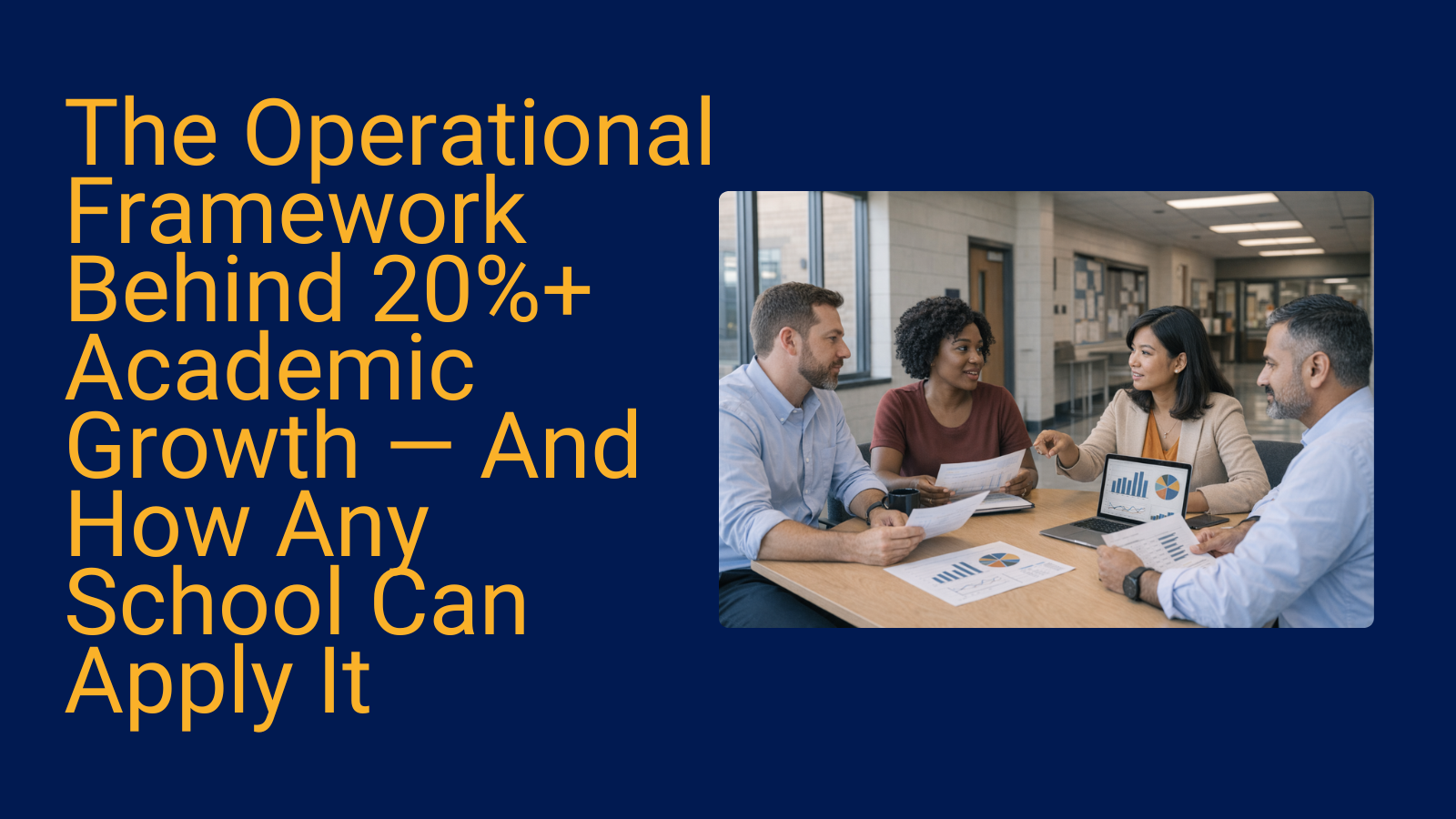
School leaders know that academic outcomes are ultimately the measure of everything they build. But the systems, decisions, and organizational disciplines that drive those outcomes — that is the operational story.
In Episode #71 of The Charter School Insider Podcast, Maryann Li, CEO of Ascend Public Charter Schools, shares how her network of 17 Brooklyn K–12 schools achieved over 20% academic growth in a single year. The results — 71% ELA proficiency, 72% in math, 62% in science, all 17 points above New York City and New York State public school averages — did not come from a new curriculum or a change in demographics. They came from three operational pillars that any school leader can build.
The framework is Mindset → Talent → Execution.
Below is a practical breakdown of what each pillar means from an operational standpoint, and how to put it to work in your organization.
Most leaders already know that steady progress matters. Consistent improvement year over year is a genuine accomplishment, and it reflects real work by real people.
The question this framework invites is a different one: what would it take to go beyond steady — to achieve the kind of results that change the trajectory of a school or a network?
Maryann's answer is that transformational outcomes are not the product of doing more of the same. They are the result of a few bold operational decisions, executed relentlessly. And those decisions start not with a new program or initiative, but with how the organization is built and led from the inside.
Every operational system in a school reflects — whether intentionally or not — what the people running it believe is possible.
Goals, staffing decisions, data review cadences, professional development investments: all of these are shaped by an underlying set of beliefs about students and about what adults are responsible for. Making those beliefs explicit is itself an operational discipline — and one that directly determines the ceiling on everything else the organization builds.
This means anchoring the entire organization around two commitments: that all students are capable of extraordinary outcomes, and that all adults are responsible for helping them achieve those outcomes. These are not aspirational statements on a wall. They are the operational starting point for every decision, every data conversation, and every system the organization designs.
How to put this into practice:
One of the most useful things a leader can do is step into their organization as a neutral observer — not as the person who built it, but as someone encountering it fresh. Listen to how people talk about goals. Notice what gets celebrated and what gets quietly accepted. That kind of observation surfaces the assumptions already embedded in operational systems, and gives leaders something concrete to work with.
From there, the work is to make the belief system explicit and tie it directly to operational behavior — in how observations are conducted, how feedback is delivered, how wins get narrated across the organization. Look for early signs of progress before they are obvious, and build the habit of calling them out. Before the whole garden blooms, there are buds. A leader who knows what they are looking for will see them everywhere.
Once mindset sets the operational direction, talent determines how far the organization can execute on it.
Schools are human-powered organizations. Technology, curriculum, and facilities all matter — but the single most important operational resource is the people implementing the strategy. Investing in talent with the same rigor applied to budgeting, procurement, or any other operational priority is one of the highest-leverage decisions a school leader can make.
This means building operational clarity around three things simultaneously: who to attract, how to develop them, and how to retain them.
Attracting the right people starts with a clear, specific profile — not a values statement, but a concrete operational description of what an excellent teacher or leader looks like in practice. What do they believe? How do they respond under pressure? What behaviors signal the right fit? Once that profile exists, it becomes a tool: for hiring decisions, for development planning, and for performance conversations.
Developing people is where some of the most meaningful operational gains are available. Ascend redesigned its professional development model from the ground up — replacing off-site, theoretical workshops with weekly two-hour instructional labs that included pre-work, direct training from network experts, and an immediate application assignment. Every teacher turned the session into a lesson plan and taught it within days. The operational discipline was narrow focus and tight feedback loops — and it moved performance across all 17 schools faster than any previous PD model had.
The same structure applied to school leaders and network staff: identify the specific development gap, design training with immediate application, and measure the result. The content changed at every level, but the operational system was the same.
Retaining talent means building an environment people want to stay in long-term. Compensation has to be competitive enough to make teaching a sustainable career. But operationally, retention is also a function of clarity — clear expectations, visible development, and an environment where people can see the impact of their work. That last element is more powerful than many leaders expect.
The third pillar is where operational systems translate belief and talent into measurable outcomes.
One of the most significant operational changes a school can make is rethinking how data flows through the organization. Most schools operate on lagging data — state test results that reflect last year's instruction, benchmark scores that arrive weeks after the instruction that shaped them. By the time a team reviews that data, the window for timely intervention has already passed.
A school should rebuild its data infrastructure around a different question: what information do leaders need to take action in the next 48 hours, not the next cycle?
That requires working backward from the operational decisions that actually mattered. What does a school leader need to adjust instruction this week? What does a network leader need to deploy support to a school right now? A school data team should build toward those end users — which means that by the time formal data reviews happens, correction is already underway and teams are aligned on the current state rather than discovering it together.
A few operational principles can emerge:
When performance gaps are widespread across a school, it often signals a coherence question at the system level — curriculum, pacing, or instructional alignment. That is an operational problem requiring an operational response.
When gaps are concentrated in specific classrooms or student groups, it points to a targeted development opportunity that can be addressed quickly with the right support structure in place.
Quantitative data and qualitative observation work best together. Regular school visits — even at the CEO level — provide the on-the-ground context that keeps data accurate and keeps operational decisions connected to what is actually happening in classrooms.
Strategic clarity is also an execution discipline. When an organization is running multiple priorities simultaneously, a clear multi-year framework is not just a planning document — it is an operational communication tool that helps every team understand how their work connects to the whole.
Mindset sets the operational direction → Talent determines execution capacity → Execution closes the gap between vision and results
The three pillars reinforce each other. A shift in organizational beliefs without investment in people produces direction without capability. Strong people without the right operational systems cannot sustain results at scale. Systems without a shared belief in what students can achieve tend to optimize for the wrong things.
When all three are built deliberately and move together, the results speak for themselves.
Start by creating space to observe your organization from a fresh perspective — listening to how people talk about goals, what feels realistic, and what the current pace of change reflects. The goal is to surface the assumptions already embedded in operational systems, and give leaders a concrete starting point for what to address first.
Make the belief system explicit and connect it directly to operational behavior. Two or three clear commitments — such as all students are capable of extraordinary outcomes, and all adults are responsible for helping them get there — give teams a concrete anchor for decisions, performance conversations, and responses to data. Beliefs become operational culture when they are reinforced in daily practice, not just in mission statements.
The most effective PD models stay close to practice and build in immediate application. Weekly training sessions with direct instruction from subject experts, followed by an application assignment — turning the session into a lesson plan and teaching it within days — create faster feedback loops than traditional workshop models. The narrower and more data-driven the focus, the more quickly results move across an organization.
Build data systems around the decisions leaders actually need to make, not around standard reporting formats. The operational goal is to shorten the distance between observation and action — moving from end-of-cycle reviews to leading indicators that support intervention within days. Pairing quantitative data with regular qualitative observation gives the most accurate and complete operational picture.
They are force multipliers. Staff who see evidence of student growth are energized by the work, not depleted by it. Operationally, this means that investing in people — through competitive compensation, strong development systems, and clear expectations — is not separate from the academic mission. It is how the academic mission gets executed consistently at scale.
Academic growth is not just an instructional challenge. It is an operational one — shaped by the belief systems leaders build, the talent they invest in, and the execution systems they put in place to make great work visible and repeatable.
Schools that recognize this connection are better positioned to move from steady progress to the kind of results that change what students and families believe is possible.
If this framework raised questions about how your organization is built — from the beliefs that shape your culture to the data systems that drive daily decisions — the next step is reflection before reaction.
🎧 Hear the full conversation with Maryann Li on The Charter School Insider Podcast
👉 Download the Transformational Growth Readiness Assessment - A single tool that walks leaders through all three pillars, rating where their organization stands on Mindset, Talent, and Execution.

To learn more about how our experts can support your operations.
.svg)
1 min read
The lessons a large CMO learned on the way to making a major back-office tech investment
1 min read
If a few critical things don’t happen before summer and during summer, the fall will be harder than it needs to be.
1 min read
Strong enrollment strategies rely on more than admissions.They depend on operations that can consistently deliver the experience families are...