

1 min read
The School Year Starts in August: But Smart Procurement Happens All Year Long
For many school leaders, “back-to-school” planning starts in late summer—but in procurement, that’s already too late. By August, prices can spike,...
6 min read
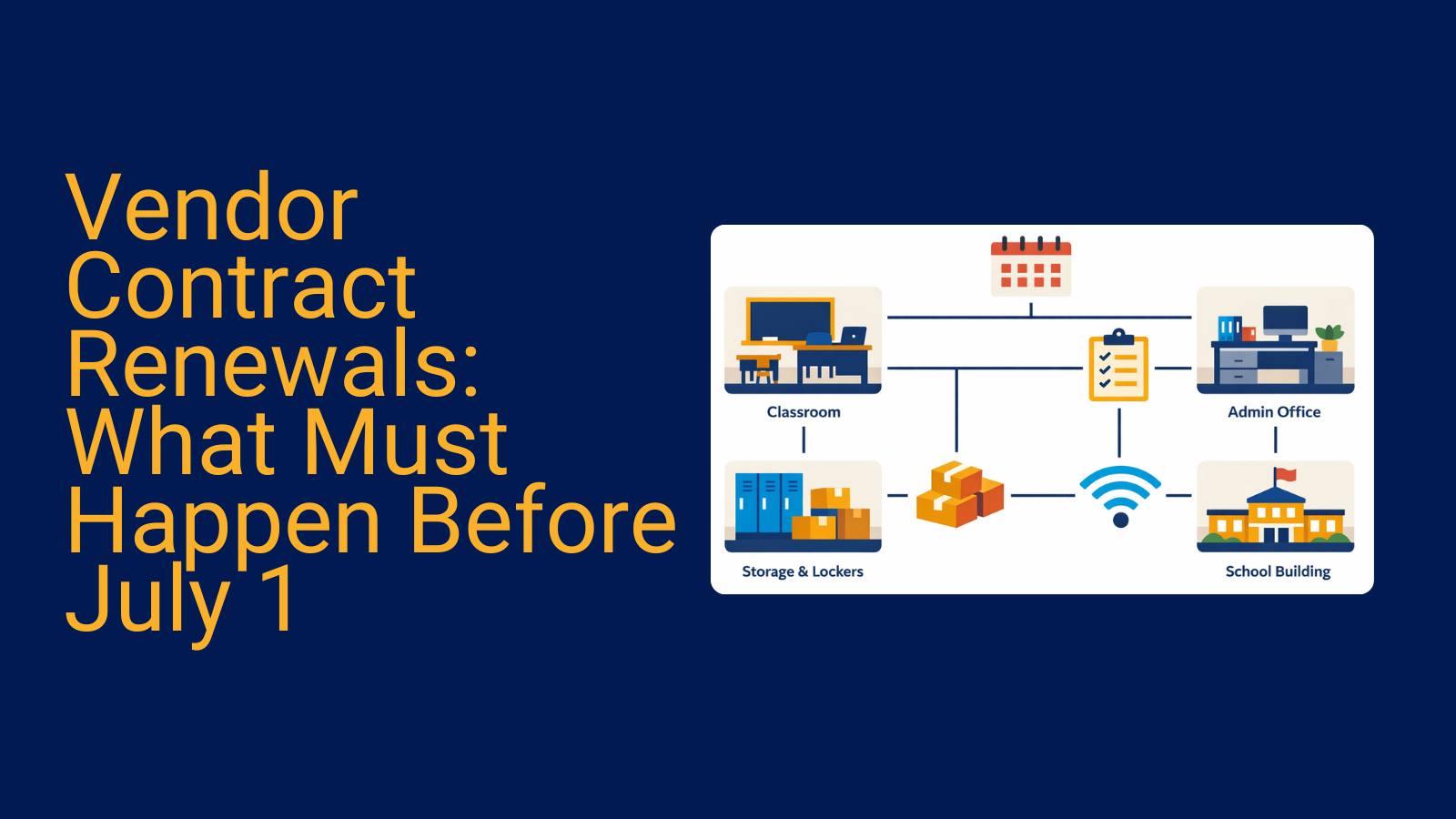
For most charter and private schools, the fiscal year resets on July 1.
So do most vendor contracts.
Curriculum platforms, technology agreements, copier leases, transportation contracts, food service providers, software subscriptions, custodial services — over years, schools accumulate dozens of these agreements, each with its own renewal date, notice window, and pricing terms. And by the last week of May, the notice windows on many of those contracts have already closed.
The result is a quiet, distributed cost most schools never see on a single budget line. Research from World Commerce & Contracting estimates that the average organization loses approximately 9% of annual value to poor contract management — including missed renewal windows, unrenegotiated auto-renewals, and price escalations that go unchallenged.
This article walks through a five-step system school operations leaders can use to recover that margin — and how to build the proactive rhythm that prevents the loss from happening again next year.
Auto-renewals work because they're silent. No invoice arrives saying you've been re-enrolled. The same invoice just keeps arriving, often slightly higher than the year before.
In a school context, the cost shows up in familiar places:
None of these are dramatic on their own. That's the issue. Across a school's full vendor base, the small leaks add up to real budget that didn't have to be spent.
Most school vendor contracts align to the fiscal year. Agreements written to run “one school year” or “annually” default to July 1 renewal dates. And most include a notice-of-non-renewal clause requiring 60, 90, or sometimes 120 days written notice to opt out.
The math is unforgiving: a 90-day notice window for a July 1 renewal means the deadline to act is April 1. By late May, many of those windows have already closed. Schools that don't have a centralized renewal calendar often don't realize a contract has auto-renewed until the next invoice arrives — and by then they're locked in for another year.
Three structural realities make schools especially exposed:
Auto-renewals only happen when no one is watching the calendar.
The schools that consistently capture savings on procurement aren't the ones with bigger teams or more time. They're the ones who built a system. The system has five working parts.
The first move is the one most schools skip: a single source of truth for every vendor contract.
At minimum, capture three things for every active agreement:
Most schools — even well-run ones — don't have this in a single place. Contracts live in email threads, shared drives, individual folders, and institutional memory. The inventory is the foundation for everything that follows.
Not every contract earns the same attention. Once the inventory exists, sort it by annual cost.
The top ten contracts by spend typically drive most of the cost. Those are the agreements that earn focused review — real evaluation, renegotiation, and consideration of alternatives. The long tail of smaller contracts can be managed with a lighter touch. Trying to manage every contract equally is how schools end up managing none of them well.
Most schools react to renewal dates. The proactive system reacts to notice deadlines — which fall months earlier.
A 90-day notice window on a January 1 renewal means the work happens in October. A 60-day notice window on a July 1 renewal means the work happens in May. Build a calendar that flags every notice window 30 days before it closes. That's when the leverage exists.
Schools that work the calendar rather than the renewal date stay ahead of every conversation.
Renewal time is leverage time — even if the school intends to stay with the incumbent.
Every renewal is a chance to revisit pricing, terms, and escalation clauses. Schools that treat each one as a real decision rather than a default consistently come away with better terms. And having a real alternative ready — a vetted option you could switch to — strengthens every conversation, whether the school switches providers or not.
Auto-renewals work when nobody is paying attention. The shift is from passive continuation to active decision-making.
The fewer contracts a school manages individually, the less likely it is to miss something. This is where group purchasing changes the math.
Group purchasing organizations pre-negotiate contracts on behalf of many schools — collapsing the inventory, calendar, and negotiation work into a single managed relationship. The contracts are vetted, the terms are pre-negotiated, and the renewal mechanics are handled at the cooperative level rather than contract by contract. For schools, that means less administrative load, stronger pricing through collective leverage, and fewer notice windows to track in the first place.
The schools that consistently capture savings don't run a contract review every June. They review the next six months of renewals every quarter.
A quarterly cadence works because it matches how notice windows actually fall throughout the year. Looking six months out captures every 90-day window and most 120-day windows. The work becomes predictable and proportional — small reviews four times a year rather than a single overwhelming audit in late spring.
Build the habit. The savings follow.
A group purchasing organization (GPO) consolidates many individual vendor relationships into a single framework. Contracts are pre-negotiated at the cooperative level on behalf of all member schools. Pricing reflects collective leverage rather than what any single school could negotiate alone. Vendor due diligence is done once, centrally, rather than school by school.
For schools facing the auto-renewal challenge, group purchasing addresses the problem structurally:
BuyQ helps schools maximize their financial resources and develop a strategic purchasing strategy. Through pre-negotiated contracting solutions and hands-on consulting support, over 4,200+ schools are saving millions with BuyQ.
If the work feels overwhelming, keep it simple:
Schools that do this consistently enter each fiscal year with fewer surprises, stronger vendor terms, and more budget pointed at students rather than locked in contracts no one had time to review.
Contract auto-renewal is a clause in most vendor agreements that automatically extends the contract for another term unless the school provides written notice of non-renewal within a defined window — typically 60 to 120 days before the renewal date. For schools, most vendor contracts align to the fiscal year and auto-renew on July 1.
Research from World Commerce & Contracting estimates that the average organization loses approximately 9% of annual value to poor contract management, including missed renewal windows, unrenegotiated auto-renewals, and unchallenged price escalations. While this figure is cross-industry, the structural challenges that drive it are particularly common in schools.
A group purchasing organization is a cooperative that pre-negotiates vendor contracts on behalf of many member schools. Pricing reflects collective leverage rather than individual negotiations, vendors are pre-vetted, and renewal mechanics are managed at the cooperative level. For schools, this reduces administrative load and provides ready alternatives when contracts need to change.
Start with a centralized inventory of every active vendor contract, capturing the vendor name, renewal date, and notice window. Prioritize the top ten by annual spend. Build a calendar that flags notice windows 30 days before they close. Treat every renewal as an active decision rather than a default. And reduce the total number of contracts to manage individually through cooperative purchasing where appropriate.
Auto-renewals don't announce themselves. They arrive as invoices that look just like last year's, just higher.
The schools that stop paying the quiet cost aren't the ones with bigger teams or more time. They're the ones who built the rhythm — and reduced the surface area to manage in the first place.
The work that matters now is different from what was possible in April. June is when the right triage happens. The rhythm starts whenever a school decides to begin.
BuyQ helps charter and private schools build vendor procurement systems that work — through pre-negotiated contracts and education-first guidance.
If your team is reviewing vendor contracts ahead of July 1, our consulting team can help you build the inventory, identify the highest-leverage agreements, and evaluate where group purchasing could reduce your administrative load.
👉 Download the Vendor Contract Renewal Tracker

To learn more about how our experts can support your operations.

1 min read
For many school leaders, “back-to-school” planning starts in late summer—but in procurement, that’s already too late. By August, prices can spike,...
1 min read
Strong enrollment strategies rely on more than admissions.They depend on operations that can consistently deliver the experience families are...
1 min read
Growth puts pressure on the fundamentals. Here are seven priorities BuyQ believes charter school leaders should reinforce early to support...